Demand Planning
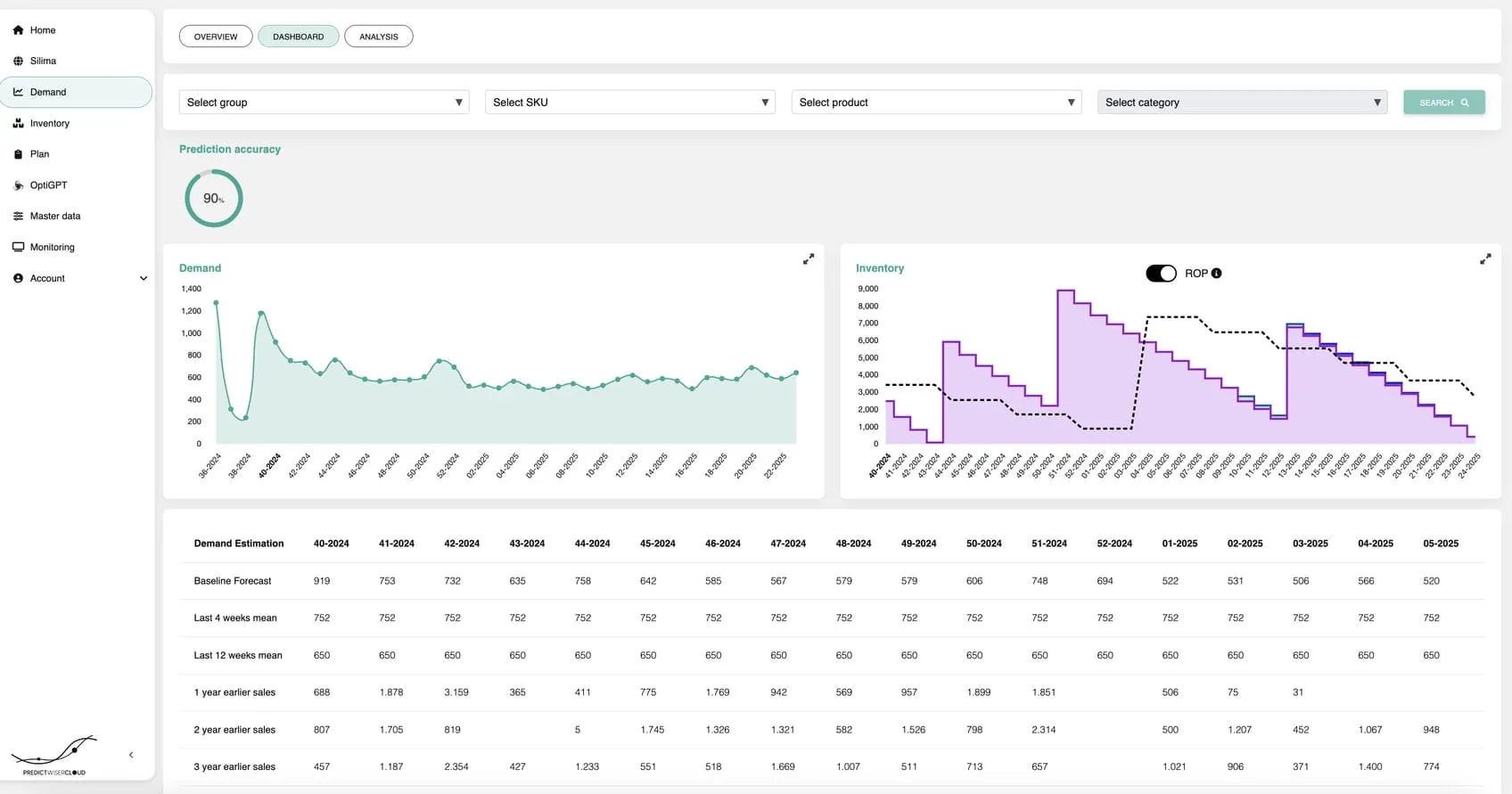
An AI-based demand planning software tailored to the needs of the FMCG-industry. We forecast the exact demand for your products using historical sales data and secondary data such as weather, high demand events, promotions, holidays and much more.
- Automatic selection of AI models
Optiwiser's proprietary technology, StreamWiser™, uses advanced AI technology to automate the demand planning process. It automatically selects the best algorithms based on their expected future performance, resulting in more accurate forecasts. StreamWiser™ dynamically adapts to different demand patterns by selecting the optimal algorithm for each period. This makes it easier to manage seasonal and demand fluctuations.
- Promotions, Weather Trends, Holidays, Events and Google Trends
To account for external influences in the forecast, additional factors are incorporated — promotions, weather, public holidays, vacation periods, special events and Google Trends are all integrated into the forecast. The result: a continuously learning AI with noticeably improved forecasting accuracy. In addition, the impact of these external factors is analyzed and presented in clear, easy-to-read charts.
- Forecasts per Client
The system also enables article-specific forecasts for individual customer groups (e.g., Aldi Nord, EDEKA) and regions (e.g., Bavaria, Germany) – a valuable support for the sales team in demand planning. In addition, sales planners are supported by statistical analyses of sales trends, allowing them to respond to changes at an early stage.

Inventory Optimization
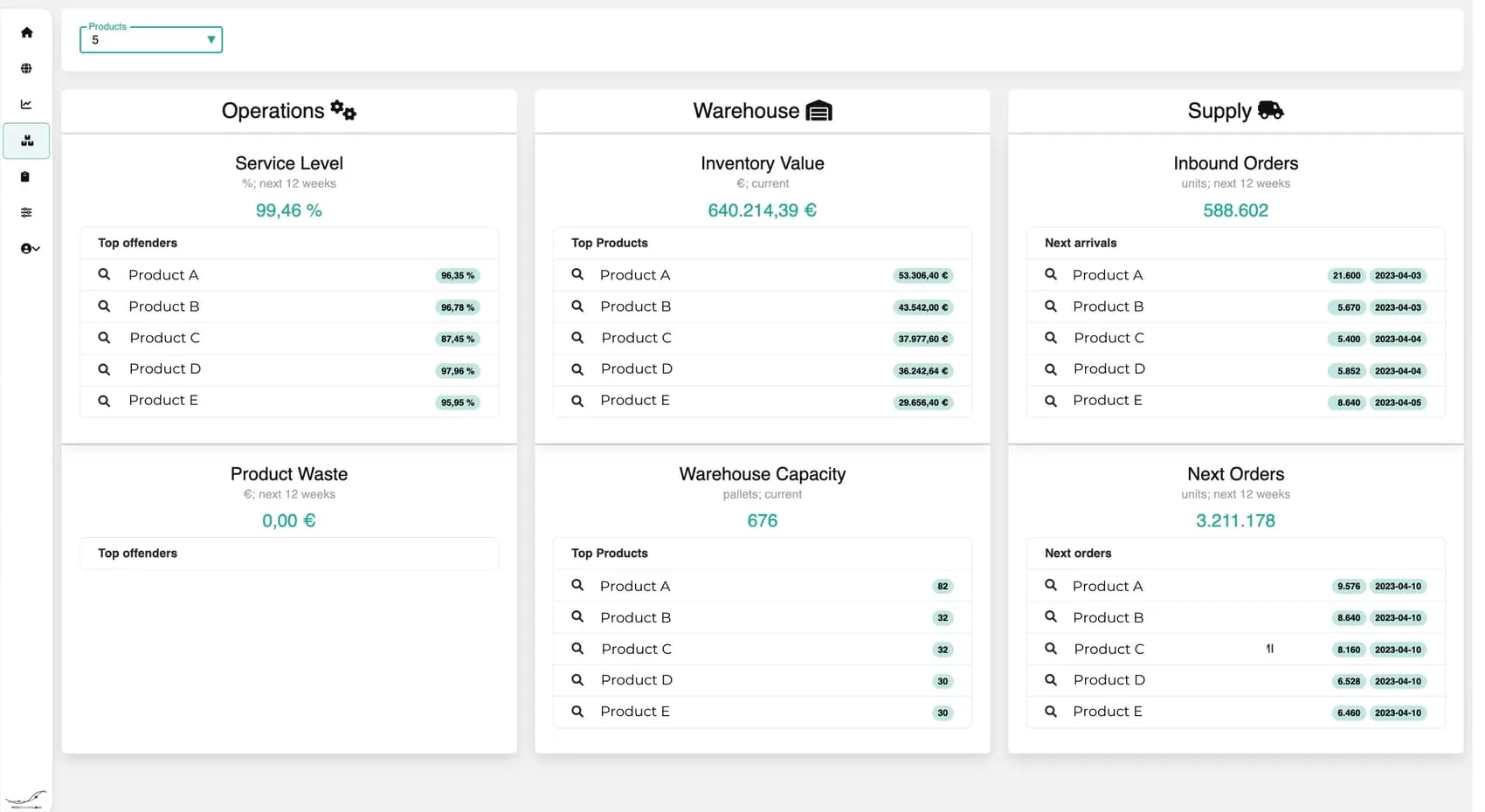
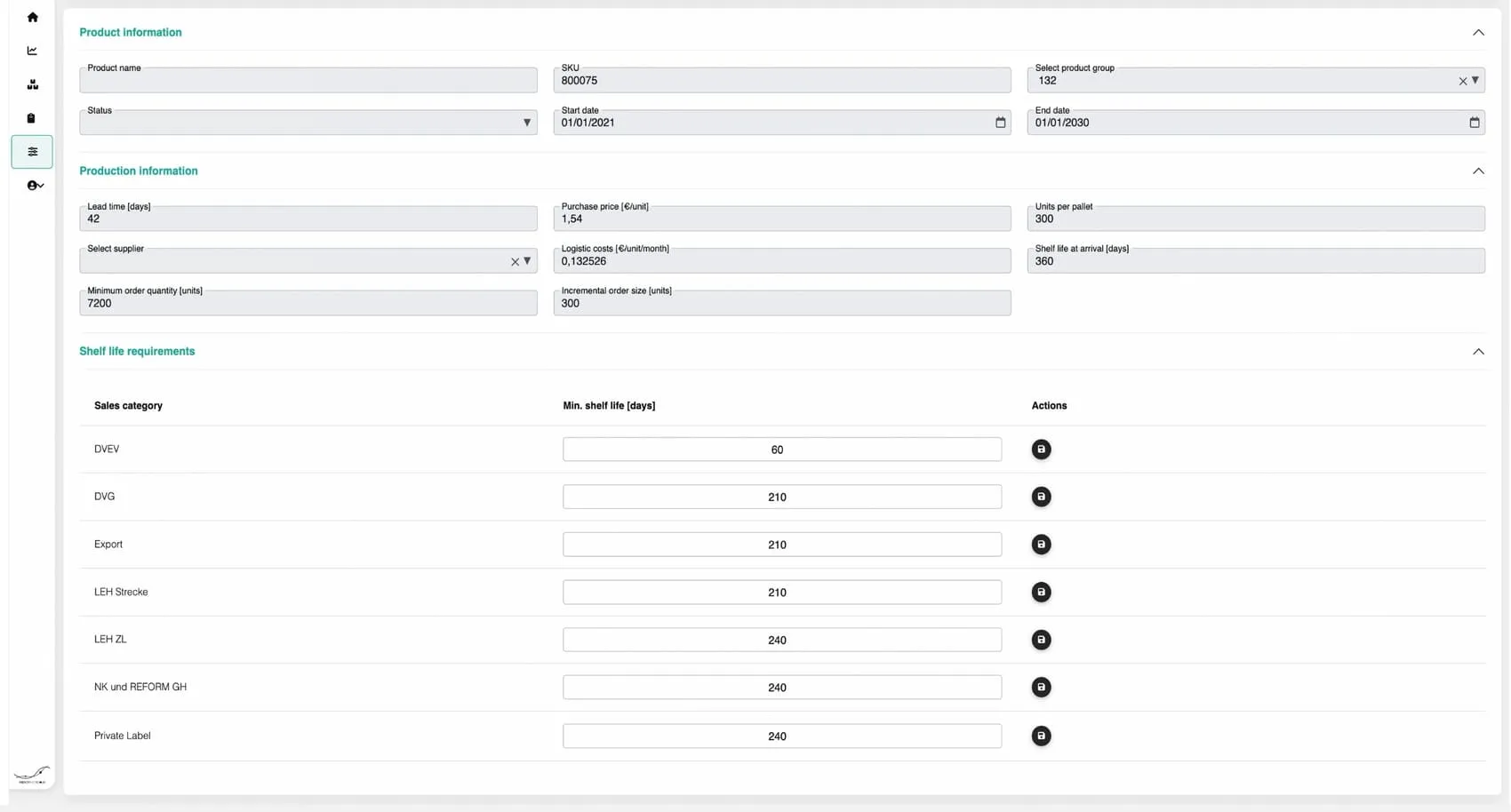
Optiwiser's inventory management is based on an algorithm that is specifically tailored to the needs of the FMCG industry. The algorithm optimizes inventories by taking into account factors such as shelf life, procurement costs, storage capacity and transport costs. In addition, the algorithm enables dynamic inventory planning by adjusting the safety stock weekly to respond to changes in demand and storage conditions.
- Less waste & overstocks
The algorithm continuously analyzes current demand forecasts, inventory levels, shelf life data, and procurement costs. On this basis, the algorithm adjusts the safety stock weekly. This way, only the amount needed to meet the expected demand is reordered, without unnecessarily tying up storage capacity. At the same time, the algorithm ensures that sufficient inventory is available to absorb sudden fluctuations in demand, minimizing stock-outs.
- Higher profits
The algorithm increases profit margins by lowering tied-up capital through optimized inventory levels, which means that less capital is tied up in excess inventory. This reduces storage costs and increases financial flexibility. Improved inventory planning helps avoid contractual penalties by ensuring that products are available on time and that delivery delays are minimized. The higher service-level makes it possible to reliably fulfill customer orders, which increases customer satisfaction and leads to follow-up orders. In addition, the algorithm reduces losses due to expired products by taking shelf life into account, thus minimizing write-offs.

Production-and Procurement Planning
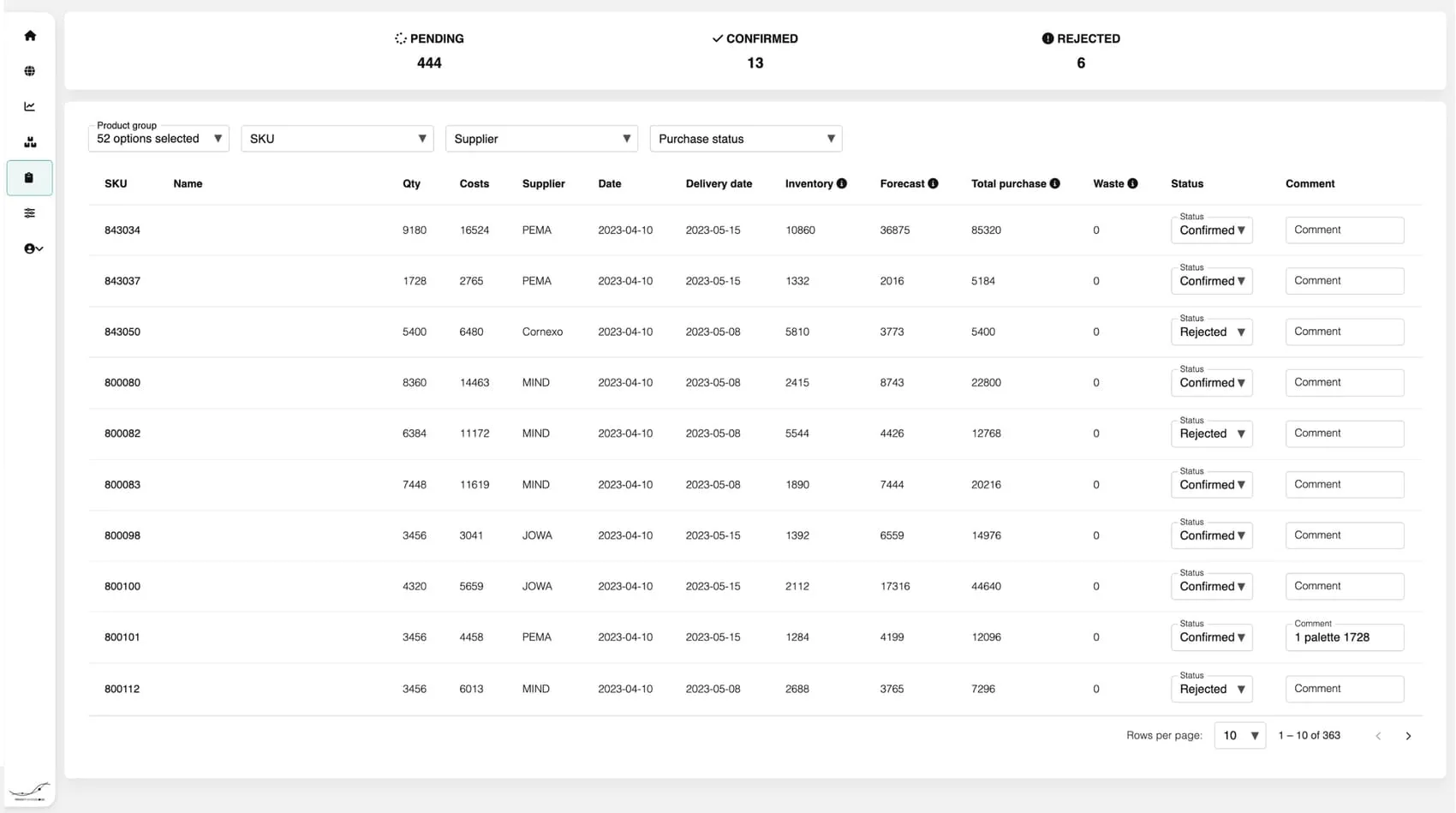
The software optimizes the entire production process by integrating real-time data and advanced algorithms. It takes into account factors such as MOQ, storage capacities, lead times, etc. to ensure efficient production planning. The module plans production orders in such a way that bottlenecks are avoided and production resources are used optimally. At the same time, stock levels and customer orders are coordinated to ensure timely delivery.
- Cost-optimal production quantity
The module offers numerous advantages, including increased efficiency through optimal use of production capacities and a reduction in setup times. It enables precise coordination of production and warehouse stocks, avoiding overproduction and allowing stocks to be managed in a targeted way. This reduces storage costs and minimizes bottlenecks and delays. The module also allows for rapid adjustment in response to fluctuations in demand, increasing flexibility and improving delivery performance. Overall, this results in lower production costs and increased profitability.
- Predictive Planning
By interacting with the AI in sales planning, the production planning module enables predictive planning using precise demand forecasts. These forecasts, based on historical sales data and secondary data such as promotions, holidays, weather etc. allow production quantities to be adjusted to future demand at an early stage. This means that production plans can be optimally aligned with upcoming demand fluctuations, increasing efficiency and avoiding bottlenecks or overcapacity. The combination of sales planning and production control ensures holistic planning that responds to current and future market demands, thus guaranteeing a high level of delivery capability at minimal cost.

Detailed Scheduling
The detailed planning module optimizes the production sequence, taking into account factors such as machine capacity, set-up times and order priorities. It guarantees efficient order planning to minimize downtime and maximize throughput. By dynamically adjusting schedules, the module helps planners to reduce bottlenecks, improve delivery reliability and increase overall production efficiency.
- Optimized Schedules
The detailed planning module optimizes the production sequence, taking into account factors such as machine capacity, set-up times and order priorities. It guarantees efficient order planning to minimize downtime and maximize throughput. By dynamically adjusting schedules, the module helps planners to reduce bottlenecks, improve delivery reliability and increase overall production efficiency.
- Developed for FMCG/Food manufacturing
The algorithm was developed in collaboration with an FMCG (food) manufacturer to meet the specific requirements of the FMCG and in particular the food and beverage industry. It optimizes planning, taking into account industry-specific requirements and production constraints, and ensures a smooth and efficient workflow. By balancing key factors, the module helps manufacturers reduce downtime, improve resource utilization and adapt quickly to changing demand.
.webp)
Material-and Packaging Planning
Material and Packaging Planning adds another layer of planning that allows companies to easily break down demand forecasts and cost-optimal production recommendations, just like a BOM explosion. This way, our customers receive the exact amount of material and packaging needed for each product to be produced!
- Higher Transparency
Optiwiser's material and packaging planning creates more transparency by providing a detailed overview of material usage and demand. By continuously tracking inventory and analyzing consumption data, companies can always see which raw materials and packaging are needed. Bottlenecks and overstocks are detected early, enabling precise control of inventory levels. This transparency simplifies planning, improves inventory control, and supports informed decisions in materials management.
- Predictive Raw Material Procurement
Material and packaging planning makes raw material procurement more predictable by generating precise demand forecasts. The system creates order proposals that are precisely aligned with expected production requirements. This enables companies to plan their orders on time and coordinate them with suppliers. As a result, delivery times can be optimally utilized and costs avoided through expensive rush orders, leading to a more stable and efficient supply of raw materials.

OptiGPT
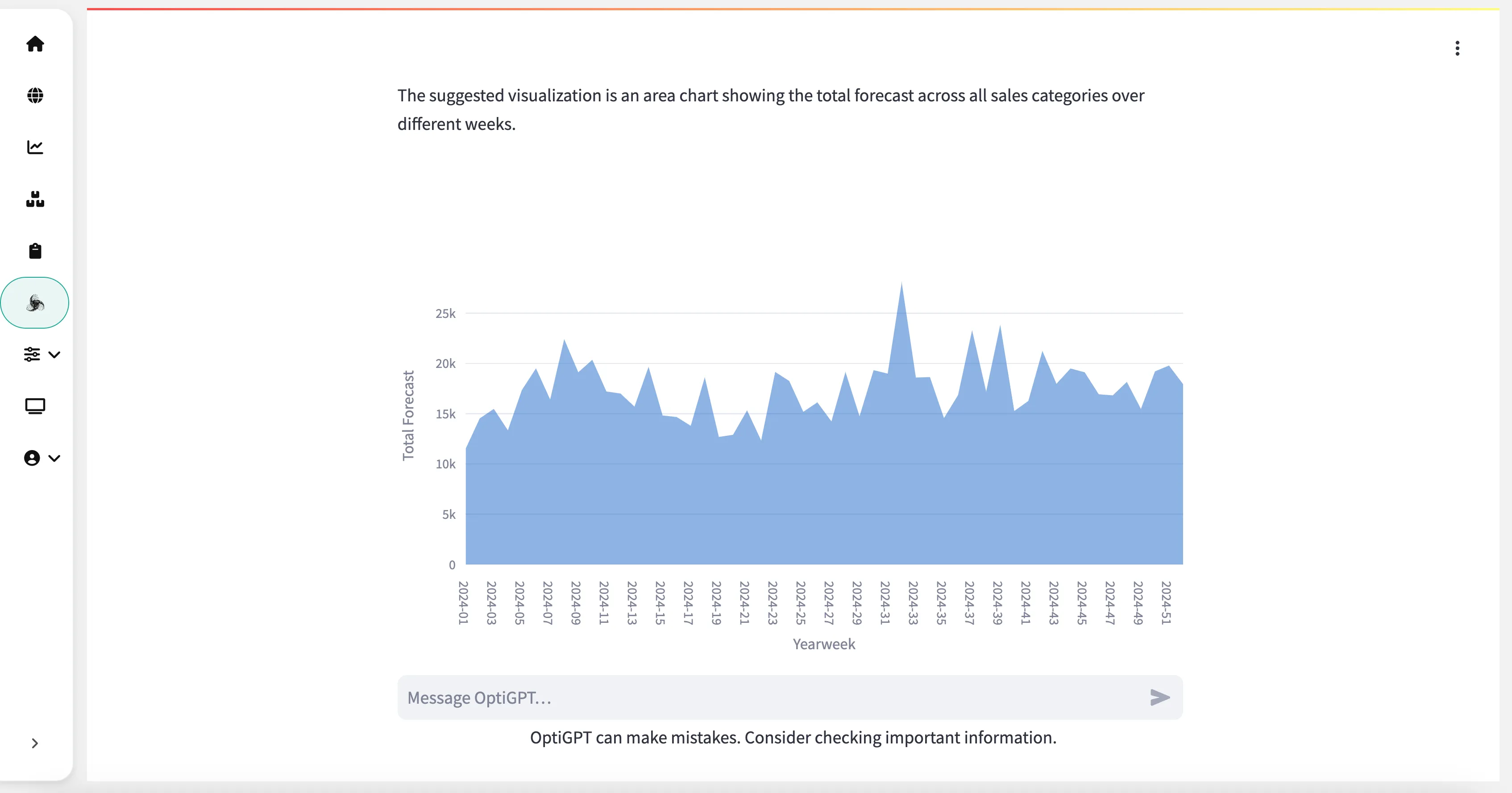
OptiGPT is an AI-based assistant for supply chain planning. The system is integrated with the database and makes it possible to get real-time insights into sales data, stock levels and production quantities with a single click. OptiGPT can create, for example, an ABC analysis, predict the sales volume of top sellers, analyze stock changes or identify the most volatile items.
- Analyses
With OptiGPT, companies can perform a variety of analyses to optimize their supply chain. This includes creating ABC analyses to categorize products according to their sales volume and importance to sales. In addition, accurate forecasts of sales volume can be created for the highest-volume items, enabling forward planning. OptiGPT analyzes changes in inventory levels to identify trends and fluctuations that are important for inventory control. In addition, the system offers the option of identifying particularly volatile items, enabling better risk assessment and management. All these analyses can be flexibly queried and displayed in clear diagrams or exportable tables, such as Excel, to support data-based decisions.
- Generative AI-models
Generative AI models are used in OptiGPT to optimize the analysis and planning processes in the supply chain. These models use machine learning to identify patterns and correlations in large amounts of data and generate predictions and recommendations based on them. For example, generative AI models can create sales forecasts by analyzing historical sales data and taking into account future trends and seasonal fluctuations. They also support the dynamic creation of ABC analyses and the identification of inventory changes by flexibly responding to user requests and delivering customized analyses in real time. In addition, the models can simulate complex scenarios, such as the effects of inventory bottlenecks or production changes, and thus provide a sound basis for decision-making. By using these AI models, OptiGPT enables more efficient planning and data-driven optimization of supply chain processes.

SILIMA – Scenario Manager
SILIMA enables companies to model changes in their supply chain and thus prepare for future developments at an early stage. Users can create what-if scenarios by selecting and adjusting various parameters to model changes in their supply chain. For example, future effects of rising costs due to inflation can be illustrated in diagrams.
- What-if Scenarios
SILIMA enables companies to create and simulate what-if scenarios to prepare for possible changes in the supply chain. Users can adjust various parameters, such as costs, demand or production capacities, to model different scenarios. For example, it is possible to simulate how rising costs due to inflation affect profitability or what impact supply bottlenecks could have on the availability of products. The results are presented in diagrams that make it easier to identify potential risks and opportunities and make informed decisions. SILIMA thus helps companies to react flexibly to changes and proactively adapt their supply chain strategies.
- Creating Customized Scenarios
With SILIMA, companies can model scenarios such as production outages, company vacations or the production of seasonal goods. For example, if a company is planning a vacation shutdown or faces a production outage or maintenance, SILIMA can calculate how much pre-production is needed to meet demand during this period and avoid delivery bottlenecks. It can also simulate seasonal products by analyzing how their production affects stock levels and production capacities in certain weeks.