

The requirements for sales planning in the FMCG industry have changed dramatically in recent years. Fluctuating demand, volatile markets, short-term retail promotions, and constantly changing consumer behavior make accurate forecasting more complex than ever. At the same time, many companies still rely on highly manual processes: scattered Excel files, individual planner assumptions, and last-minute coordination before budget meetings.
The problem is that traditional forecasting processes are increasingly reaching their limits. They are time-consuming, error-prone, and often unable to reliably capture short-term changes or long-term developments. This is exactly where modern AI forecasting comes in, fundamentally transforming the way companies plan demand.
AI Forecasting for FMCG: Rethinking Sales Planning
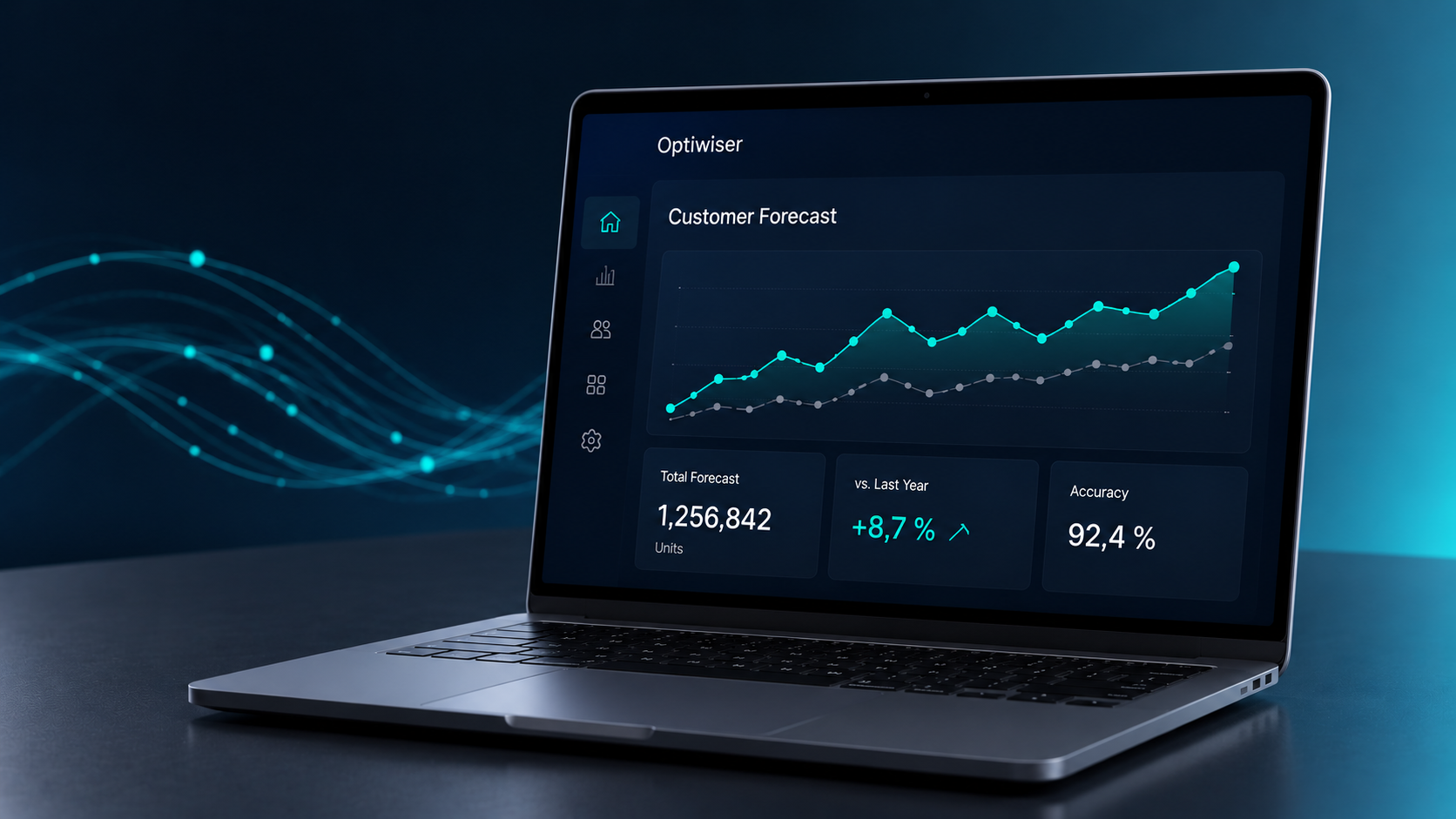
With its AI-powered Customer Forecasting Module, Optiwiser has developed a solution specifically tailored to the needs of modern FMCG sales teams. Instead of isolated data silos and manual planning steps, companies gain access to a centralized platform that automates forecasts, continuously improves accuracy, and provides significantly greater transparency. At the core of the solution is intelligent, data-driven demand planning. The AI analyzes historical sales data and combines it with external influencing factors such as weather developments, promotions, holidays, and market trends. This creates forecasts that go far beyond traditional historical analysis and enable companies to identify actual demand shifts at an early stage.
Greater Transparency for Sales Teams and Management
Especially in the FMCG environment, with complex sales structures, thousands of SKUs, and multiple retail chains, transparency becomes a critical success factor. This is where AI forecasting creates enormous value. With Optiwiser, sales teams can filter forecasts by customer groups such as REWE, EDEKA, or dm, as well as by regions and sales territories. Positive and negative customer developments become visible much earlier, enabling companies to react proactively to market changes. At the same time, the system supports flexible budget and sales planning by combining baseline forecasts with promotional overlays. Short-term demand shifts and long-term trends can be analyzed within the same view, resulting in significantly more informed decisions.
Planning granularity also plays a key role: companies can seamlessly switch between weekly and monthly views and adapt forecasts precisely to their operational requirements.
From Historical Sales Data to Intelligent Predictions
Many companies still base demand planning primarily on historical sales figures. Modern AI models, however, go far beyond this approach. Instead of simply extrapolating past values, AI identifies patterns and correlations within large datasets while simultaneously incorporating external factors that traditional planning systems often fail to capture adequately.
These include, for example:
● Weather developments
● Promotions and campaigns
● Holidays and seasonal effects
● Market and consumer trends
Particularly in the FMCG industry, these factors can have a massive impact on actual demand. AI forecasting enables companies to identify these dynamics early and adjust their planning accordingly. The result is more accurate forecasts, better alignment between sales, production, and procurement, and significantly greater planning reliability across the entire supply chain.
How much potential is hidden in your planning?
Discover in a free potential analysis where forecasting, inventory, production or purchasing can be optimized.
AI Forecasting as the Foundation for More Efficient Supply Chains
Accurate forecasts impact far more than just sales planning—they influence the entire supply chain. Inaccurate demand forecasts often lead to excess inventory, out-of-stock situations, unnecessary capital commitment, and inefficient production processes.
With AI-powered planning, companies can manage their operations much more efficiently. Improved forecast quality enables smarter production planning, optimized inventory levels, and demand-driven procurement. The intelligent connection between demand and production helps businesses use resources more efficiently while simultaneously improving service levels. This is particularly important in industries dealing with perishable products, such as food and beverage manufacturing.
Why AI Forecasting Is Becoming Increasingly Important for FMCG Companies
The FMCG industry is one of the most dynamic markets in the world. Short product life cycles, high promotional intensity, and volatile demand make traditional forecasting methods increasingly insufficient. Even small forecasting errors can have significant financial consequences. Excess inventory leads to high storage costs and food waste, while stock shortages directly result in lost revenue and dissatisfied customers.
AI forecasting helps companies significantly reduce these risks while also creating new opportunities to automate processes and make faster, data-driven decisions.
As a result, companies benefit from:
● Higher forecast accuracy
● Lower inventory costs
● More efficient production processes
● Reduced write-offs and waste
● Improved service levels
Forecasting is therefore evolving into a strategic competitive advantage.
Which Companies Benefit Most from AI Forecasting?
AI forecasting is particularly relevant for companies with complex sales and planning structures. This includes manufacturers in the food, beverage, and cosmetics industries, as well as other FMCG businesses with extensive product portfolios and strong seasonal demand fluctuations.
Mid-sized companies, in particular, often face the challenge of modernizing planning processes without building large internal data science teams or launching complex IT projects. This is exactly where Optiwiser comes in: the solution was specifically designed to make AI-powered planning practical, fast to implement, and easy to adopt.
AI Forecasting Is Changing the Role of Planning
Forecasting is increasingly evolving from an operational process into a strategic management tool. Companies that adopt AI-based forecasting methods early create the foundation for more resilient supply chains and better decision-making. With solutions like Optiwiser, businesses gain not only more accurate forecasts but also a holistic platform for optimizing planning—from demand to production.
In addition, the AI assistant OptiGPT helps companies automate data analysis and make complex relationships easier to understand. As a result, decisions become not only more data-driven but also significantly faster.
AI Forecasting Becomes a Competitive Advantage
The era of forecasting based on isolated Excel files and gut feeling is increasingly coming to an end. Modern AI solutions enable planning that is significantly more accurate, faster, and more transparent. Especially in the FMCG industry, AI forecasting is becoming a decisive success factor, for better decisions, more efficient processes, and a more sustainable supply chain.
Optiwiser demonstrates how companies can implement this transformation in a practical way and modernize their sales planning step by step, without complex IT projects, but with measurable value across the entire value chain.
.png)